Category: Articles

  • ERP vs. Fractional Demand Planning: The Forecasting Fix CPG Brands Need

    ERP vs. Fractional Demand Planning: The Forecasting Fix CPG Brands Need

    Introduction

    For CPG brands, demand forecasting isn’t just about guessing how much stock to keep on shelves—it’s the foundation of profitability, operational efficiency, and customer satisfaction. Yet many consumer packaged goods (CPG) companies rely heavily on ERP systems or legacy forecasting software, only to find themselves plagued with stockouts, bloated inventory, and costly forecasting mistakes.

    The truth? ERP systems weren’t built for dynamic demand planning. What growing brands need is an expert-led, adaptive approach that turns data into action. That’s where fractional demand planning enters the picture.

    In this post, we’ll break down the key differences between ERP-based forecasting and fractional demand planning, why the latter is fast becoming the go-to solution for modern CPG brands, and how to know when it’s time to make the switch.


    📚 Table of Contents

    1. Introduction

    2. Why Forecasting Is Critical for CPG Brands

    3. Why Brands Default to ERPs for Forecasting

    4. The Limitations of ERP Demand Forecasting

    5. What Is Fractional Demand Planning?

    6. Fractional vs. ERP Forecasting: Key Differences

    7. Top Benefits of Switching to Fractional Demand Planning

    8. When to Consider Fractional Demand Planning

    9. The W.NDeen Advantage: Strategy Meets Execution

    10. Frequently Asked Questions

    11. Next Steps: Fix Your Forecasting


    Why Forecasting Is Critical for CPG Brands

    Whether you’re managing a $10M startup or a $500M national brand, demand planning can make or break your bottom line. When done right, it:

    • Reduces costly stockouts that frustrate customers
    • Minimizes excess inventory that ties up cash
    • Improves supply chain agility and reduces waste
    • Enables smarter promotional planning and product launches

    But forecasting is no longer about spreadsheets and guesswork—it’s about real-time adaptation to shifting market dynamics, consumer behavior, and supply disruptions.


    Why Brands Default to ERPs for Forecasting

    Despite their forecasting limitations, ERP systems remain the default choice for many brands. Why?

    • Familiarity and legacy use: Most companies already use an ERP for operations, so it feels natural to lean on it for forecasting too.

    • Vendor upselling: Many ERP platforms promote forecasting modules as a simple add-on—without explaining the real limitations.

    • False sense of security: Because it’s “all-in-one,” it feels complete, even if it underperforms in execution.

    • Lack of forecasting expertise: Teams without trained demand planners assume the software can do it all.

    But in reality, these reasons are what trap brands in reactive inventory cycles. Forecasting isn’t just a feature—it’s a strategy.


    The Limitations of ERP Demand Forecasting

    ERPs Are Not Built to Predict the Future

    ERP systems are exceptional at storing, managing, and reporting on structured data. But forecasting? That’s not their strength.

    Here’s where they fall short:

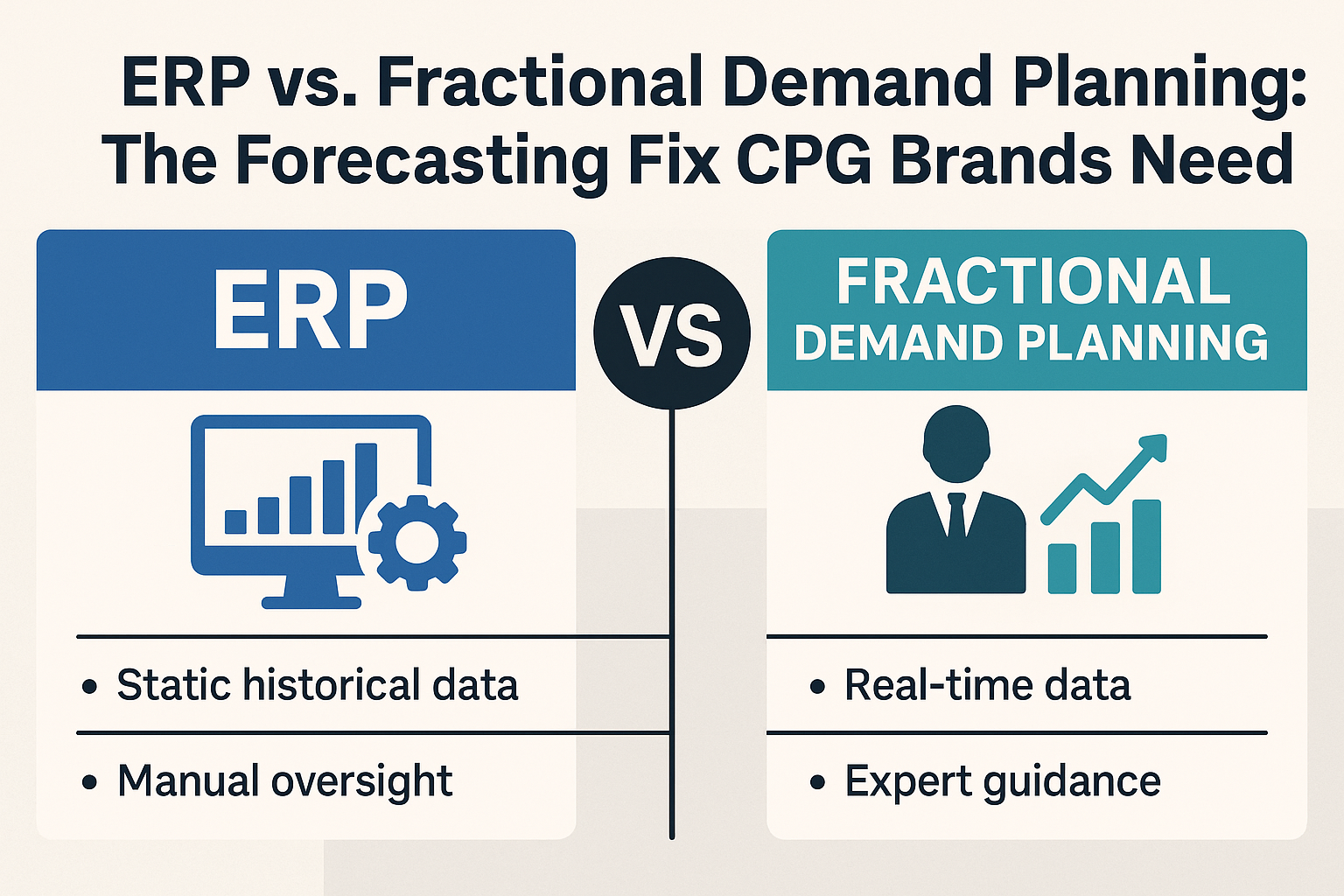
    ❌ Static Historical Data
    Most ERPs rely heavily on historical sales patterns. But what happens when consumer demand shifts due to trends, inflation, or competitor actions? ERPs don’t adjust automatically.

    ❌ Limited Analytical Intelligence
    ERPs generate dashboards, not decisions. While they can show you data, they rarely translate that into strategic inventory or production recommendations.

    ❌ Manual Overload
    ERP forecasting modules require constant human input and oversight. This makes them prone to errors, over-forecasting, or underestimating demand altogether.

    Example: One CPG brand we worked with had their ERP over-forecast by 40%, leading to excess stock that froze millions in working capital and warehouse costs.


    What Is Fractional Demand Planning?

    Fractional Demand Planning is an outsourced, expert-led approach to demand forecasting and inventory optimization. Instead of relying solely on software, brands tap into a dedicated team of supply chain professionals—at a fraction of the cost of hiring in-house.

    This approach blends historical data, market signals, promotions, seasonality, and category intelligence to build dynamic, actionable forecasts.

    Key Features:

    • Proactive Forecasting using real-time data and market trends

    • Hands-on Optimization that aligns inventory with actual demand

    • Actionable Insights, not just reports or dashboards

    It’s not just consulting—it’s strategic execution.


    Fractional vs. ERP Forecasting: Key Differences

    Feature ERP Systems Fractional Demand Planning
    Forecasting Intelligence Rule-based, historic data Real-time + strategic inputs
    Flexibility Rigid, requires customization Agile and adaptable
    Cost High upfront and ongoing license fees Flexible, fractional pricing
    Execution DIY with software support Done-with-you by experts
    Insights Reports and dashboards Strategic recommendations


    Top Benefits of Switching to Fractional Demand Planning

    If you’re still on the fence, here’s a quick snapshot of what fractional demand planning brings to the table:

    • Faster Forecast Adjustments – Real-time response to market conditions

    • Smarter Inventory Positioning – Allocate products by channel, season, and geography

    • More Capital Efficiency – Reduce overproduction and free up working capital

    • Cross-Team Alignment – Sales, ops, and marketing all plan from a unified strategy

    • Scalable Support – Get expert guidance only when you need it—no full-time overhead

    It’s not just a fix—it’s a growth enabler.


    When to Consider Fractional Demand Planning

    Here are a few signs it’s time to rethink your forecasting setup:

    • Chronic stockouts or excess inventory despite ERP investment

    • Slow response to supply chain disruptions or consumer shifts

    • Relying on gut feel or manual corrections to make sense of ERP reports

    • Launching new SKUs or entering new markets with no forecasting model in place

    • Team bandwidth is stretched, and you need forecasting help but can’t justify a full-time hire

    Fractional Demand Planning gives you enterprise-grade forecasting—without the enterprise-sized cost or complexity.


    The W.NDeen Advantage: Strategy Meets Execution

    At W.NDeen Advisory, we go beyond analytics. We become your forecasting partner.

    Here’s what sets us apart:

    ✅ End-to-End Forecasting Strategy

    We don’t just plug in numbers—we dive deep into your business model, product lifecycle, and customer data to create a forecasting strategy aligned with your goals.

    ✅ Execution That Drives Results

    We don’t hand you a 50-slide report and disappear. Our team works with your operations, sales, and supply chain functions to execute the plan, monitor results, and adjust in real time.

    ✅ Cost-Effective Partnership

    No long-term contracts. No six-figure software deals. Just real results and measurable ROI.


    Frequently Asked Questions

    What’s the difference between ERP and demand planning software?

    ERP systems are built for data management and operations. Demand planning software offers more advanced forecasting features but often still requires manual oversight. Fractional demand planning combines human expertise with dynamic data analysis for smarter decisions.

    Can fractional demand planning integrate with my existing ERP?

    Absolutely. We work alongside your current ERP to enhance its capabilities—not replace it. Think of it as plugging expert forecasting into your existing workflow.

    How quickly can I see results?

    Many clients start seeing improvements in forecasting accuracy and inventory efficiency within the first 30–60 days of engagement.

    Is fractional demand planning expensive?

    Not at all. It’s a cost-effective alternative to hiring full-time planners or investing in another expensive tool. You pay only for the expertise and support you need.

    What industries benefit most from fractional demand planning?

    While we specialize in CPG, our approach also benefits retail, ecommerce, and any product-based business managing complex inventory and supply chains. 


    Next Steps: Fix Your Forecasting

    Let’s Turn Forecasting Into a Competitive Advantage

    Still relying on gut feel, spreadsheets, or outdated ERP forecasts? It’s time to future-proof your operations. At W.NDeen Advisory, we’re not just advisors—we’re hands-on partners in your demand planning journey.

    Our fractional model is built for flexibility, precision, and results. Whether you’re launching new products, scaling nationally, or recovering from inventory challenges, we’ll help you build a forecasting system that works.

    📩 Ready to stop guessing and start growing? Book your free consultation today and take the first step toward demand clarity and smarter inventory management.


  • When SMBs Go to the Cloud, On-Premises IT Infrastructure Is Still Necessary

    When SMBs Go to the Cloud, On-Premises IT Infrastructure Is Still Necessary

    The new wordpress theme called Consulting WP has been lauded by critics for its presentation. The theme is made by Style Mix Themes, who have been key players in the theme industry for a long time. People were excited to see what they would come up with next; their specialty has always been designing industry specific themes. This time they have focused on the consultation industry and have hit a home run.

    There are many great things within the theme which are the cause of its popularity. The biggest factor is the appearance of the theme; it disrupts theme design clichés without being unprofessional. The different possible color combinations are also being appreciated by many companies. The theme continues to rise in popularity and many other companies have expressed an interest in deploying it on their new websites. The creators of the theme are happy with the response and have vowed to create further themes exploring the same concepts

    • Growth through innovation/creativity:
      Rather than be constrained by ideas for new products, services and new markets coming from just a few people, a Thinking Corporation can tap into the employees.
    • Increased profits:
      The corporation will experience an increase in profits due to savings in operating costs as well as sales from new products, services and ventures.
    • Higher business values:
      The link between profits and business value means that the moment a corporation creates a new sustainable level of profit, the business value is adjusted accordingly.
    • Lower staff turnover:
      This, combined with the culture that must exist for innovation and creativity to flourish, means that new employees will be attracted to the organization.
  • Harvest great ideas from your company’s best assets

    Harvest great ideas from your company’s best assets

    Many businesses, large and small, have a huge source of great ideas that can help them improve, innovate, and grow, and yet so many of these companies never think of using this amazing corporate asset. What is this highly valuable asset? Its own people. Says Morgan Fraud, the author of The Thinking Corporation, “Given that we are all capable of contributing new ideas, the question becomes how do you successfully generate, capture, process and implement ideas?” Becoming an organization capable of answering this question can benefit in a number of ways:

    • Growth through innovation/creativity:
      Rather than be constrained by ideas for new products, services and new markets coming from just a few people, a Thinking Corporation can tap into the employees.
    • Increased profits:
      The corporation will experience an increase in profits due to savings in operating costs as well as sales from new products, services and ventures.
    • Higher business values:
      The link between profits and business value means that the moment a corporation creates a new sustainable level of profit, the business value is adjusted accordingly.
    • Lower staff turnover:
      This, combined with the culture that must exist for innovation and creativity to flourish, means that new employees will be attracted to the organization.
  • Three Social Media Hacks for the Busy Entrepreneur

    Three Social Media Hacks for the Busy Entrepreneur

    The new wordpress theme called Consulting WP has been lauded by critics for its presentation. The theme is made by Style Mix Themes, who have been key players in the theme industry for a long time. People were excited to see what they would come up with next; their specialty has always been designing industry specific themes. This time they have focused on the consultation industry and have hit a home run.

    There are many great things within the theme which are the cause of its popularity. The biggest factor is the appearance of the theme; it disrupts theme design clichés without being unprofessional. The different possible color combinations are also being appreciated by many companies. The theme continues to rise in popularity and many other companies have expressed an interest in deploying it on their new websites. The creators of the theme are happy with the response and have vowed to create further themes exploring the same concepts

    • Growth through innovation/creativity:
      Rather than be constrained by ideas for new products, services and new markets coming from just a few people, a Thinking Corporation can tap into the employees.
    • Increased profits:
      The corporation will experience an increase in profits due to savings in operating costs as well as sales from new products, services and ventures.
    • Higher business values:
      The link between profits and business value means that the moment a corporation creates a new sustainable level of profit, the business value is adjusted accordingly.
    • Lower staff turnover:
      This, combined with the culture that must exist for innovation and creativity to flourish, means that new employees will be attracted to the organization.
  • Stick with Your Concept but Do Your Homework

    Stick with Your Concept but Do Your Homework

    The new wordpress theme called Consulting WP has been lauded by critics for its presentation. The theme is made by Style Mix Themes, who have been key players in the theme industry for a long time. People were excited to see what they would come up with next; their specialty has always been designing industry specific themes. This time they have focused on the consultation industry and have hit a home run.

    There are many great things within the theme which are the cause of its popularity. The biggest factor is the appearance of the theme; it disrupts theme design clichés without being unprofessional. The different possible color combinations are also being appreciated by many companies. The theme continues to rise in popularity and many other companies have expressed an interest in deploying it on their new websites. The creators of the theme are happy with the response and have vowed to create further themes exploring the same concepts

    • Growth through innovation/creativity:
      Rather than be constrained by ideas for new products, services and new markets coming from just a few people, a Thinking Corporation can tap into the employees.
    • Increased profits:
      The corporation will experience an increase in profits due to savings in operating costs as well as sales from new products, services and ventures.
    • Higher business values:
      The link between profits and business value means that the moment a corporation creates a new sustainable level of profit, the business value is adjusted accordingly.
    • Lower staff turnover:
      This, combined with the culture that must exist for innovation and creativity to flourish, means that new employees will be attracted to the organization.
  • Narrow Your Focus to Prevent Overanalysis

    Narrow Your Focus to Prevent Overanalysis

    The new wordpress theme called Consulting WP has been lauded by critics for its presentation. The theme is made by Style Mix Themes, who have been key players in the theme industry for a long time. People were excited to see what they would come up with next; their specialty has always been designing industry specific themes. This time they have focused on the consultation industry and have hit a home run.

    There are many great things within the theme which are the cause of its popularity. The biggest factor is the appearance of the theme; it disrupts theme design clichés without being unprofessional. The different possible color combinations are also being appreciated by many companies. The theme continues to rise in popularity and many other companies have expressed an interest in deploying it on their new websites. The creators of the theme are happy with the response and have vowed to create further themes exploring the same concepts

    • Growth through innovation/creativity:
      Rather than be constrained by ideas for new products, services and new markets coming from just a few people, a Thinking Corporation can tap into the employees.
    • Increased profits:
      The corporation will experience an increase in profits due to savings in operating costs as well as sales from new products, services and ventures.
    • Higher business values:
      The link between profits and business value means that the moment a corporation creates a new sustainable level of profit, the business value is adjusted accordingly.
    • Lower staff turnover:
      This, combined with the culture that must exist for innovation and creativity to flourish, means that new employees will be attracted to the organization.